Annual Letter 2025: Rounding the Corner on Our Fourth and Fifth Youth-Friendly Spaces
- Nov 11, 2025
- 10 min read
Updated: May 10
It’s that time again—with Thanksgiving upcoming this week and Giving Tuesday a week later on December 2—for us to reach out with news of our heart venture in the Southern Province of Zambia. May we begin with an expression of deepest gratitude for your engagement with our work—without you, friends and family—we would not be rounding the corner on our fourth and fifth youth-friendly spaces in rural Zambia.
You made all of this happen.
For those new to our venture, our NGO Tonga Teen Corners constructs peer-run, youth-friendly spaces in rural medical clinics, bringing together Dr. Dominique Delor’s, Dr. Anne Thomasset’s and Dr. Celeste Schenck’s shared interest in the conjoined and synergistic work of public health and education.
Everything we accomplish in Zambia as the founders of Tonga Teen Corners is deeply grounded in the power of prevention to ensure public health, and is always in concert with the work of our Zambian partner NGO on the ground, On Call Africa, and the Zambian Ministry of Health. OCA works, as do we, in strict alignment with the Zambian government and its vision for public health by supporting and strengthening its centers of care, by conducting studies to determine and prioritize the neediest, most populous and most remote sites to renovate; by handing off earlier and earlier in the process these fully renovated medical centers to Zambian district health offices that will manage and maintain them henceforth; and by designing baseline studies and monitoring impact of programs, so as to demonstrate the achievement of objectives.

This past year has brought immense change to our work in Zambia, as well as abundant evidence that our investments there—fueled by your incredible generosity—are already beginning to pay off in terms of the objectives we set a few years ago. When students have role models, support, peer counselors, and are invited to share knowledge and experiences in the youth-friendly spaces we build, everyone benefits from the resulting decrease in school leaving, teenage pregnancies, unwanted pregnancies, early marriage, sexually transmitted diseases and addictive behaviors. Below, a few highlights from this year’s (fourth) trip to Zambia and our plans for 2026.
The Year that Was 2025

One of the most important meetings we held during our March 2025 trip to Zambia was with a fully reconfigured On Call Africa staff. Part of the vision for this NGO, based in the UK, was to turn over its management progressively to an all-Zambian team.
Alongside a dynamic CEO Nkandu Chikonde, who is based in the capital city Lusaka, is the Livingstone-based team led by country director Eunice Sinyemu; it includes head of programs Adhikharhi Chimbi, engineer and procurement manager Daniel Namasumo, volunteers and youth coordinator Kasonde Mulenga, amongst a much-expanded staff of committed young coordinators and seasoned financial and development staff based in the UK.
We spent two days with them learning about their newly crafted vision and strategies for moving forward in Zambia. Amongst these were sound transition to a fully Zambian staff, prioritization of clinics with the most demand at the farthest distance from hospitals, and transfer of responsibility for such rural medical centers to the community (fueled by a network of trained volunteers) and district health offices.

These new methods of collaboration with an increasingly accountable community are solid, deeply anchored in the community itself, and proudly self-sustaining. We found OCA’s new strategies fully coherent with our own observations of needs in the field and delighted in the team’s passion for the work, and its professionalism and sense of direction under Nkandu’s leadership. The team also shared their audited statements with us, and came in, for the second year in a row, on time and on budget on both projects we accomplished together. We came away confident in their decisions, excited by the plans, and reinspired by the work we share with On Call. From one year to the next, we exult in the evolution of the project on the ground that is increasingly adapted to local needs, culture and capacity. Boundaries are sharp and clear: we provide, with OCA, infrastructure and method; the government provides staffing, training, and accountability for ongoing upkeep and maintenance.
Chidi and Mapatizya
The first of our two 2025 sites, Chidi, has become OCA’s model for the first fully renovated center designed in partnership with the Ministry of Health. The Chidi health center is inclusive of all six pillars in the government’s public health vision--infrastructure, governance and leadership, community-based volunteers, medicine, service delivery, and prevention-based, youth engagement—and it has shown itself to be capable of advancing under its own leadership once the work of infrastructure renovation and furnishing was complete. Chidi functions today with a large number of community-based volunteers who are given bicycles, uniforms, training and medical kits, and who travel to the farthest reaches of the district monitoring chronic illnesses and screening for health issues with subsequent referral to the clinic. All the training of student leaders for the youth-friendly space and the community-based volunteers (following a curriculum created originally by On Call Africa) now falls to the center’s district health office right from the start.

Last March, we returned to see a bustling Chidi that enjoyed increased staffing (provided by the government at the issue of renovation when a “post” is upgraded to a “center”), as well as clean, organized spaces for treatment where the year before there had been crowds of people waiting in the sun to be seen in dilapidated, multi-person examination and treatment rooms. Meeting again with the one, overburdened, middle-aged male nurse we met the year before in the finished youth-friendly space—the one your contributions last year made possible—along with the students themselves was a deeply moving experience for us. In July 2025, the center was officially handed over to the community. Here are a few before and after photos to show you what this work accomplishes for a community. The sky is the same intense blue, but what a difference these upgrades of infrastructure (and the addition of volunteers’ bicycles) make!
The second center that On Call undertook to renovate last year was Mapatizya, an almost unbelievably remote place some 70 miles from a hospital. We made our “before” visit in March 2025 and were pained to see how badly the facility needed renovation, despite the sparkling carpet of amethysts covering the ground surrounding the clinic.

As at Chidi, OCA undertook at Mapatizya another major overhaul that included building the youth-friendly, independent space, a large maternity annex, ablution blocks and latrines, installation of solar power and a water system, as well as the capacity strengthening and sustainability training that enrolls community volunteers and student peer advisors in the management and upkeep and daily functioning of the service. Mapatizya is very nearly finished (on time before the December/January rains begin) and will be fitted out and likely handed over to the community by early Spring. Twenty peer educators have already been selected for training beginning in February. They will play a key role in advocating for health awareness and promoting responsible decision-making among their peers. In addition, Mapatizya already has a baseline analysis of youth awareness of public health issues, sexual and reproductive health, and cultural ideas in the community as well as some baseline data on teen pregnancies, STDs and school leaving. We will visit this clinic again in March when we return to Zambia this year. Mapatizya will come in at roughly $10, 000 as planned, and has already been covered by Tonga Teen Corners’ 2025 donation. So, mission very nearly accomplished there too.
Simonga, now a Center of Excellence
A few more reflections from our March 2025 trip. While we were in Livingstone this past March, we returned, of course, multiple times to our beloved Simonga, located close to Livingstone and first in our hearts because it was our first center. It has, as we all dreamed, become a center of excellence where young medical and nursing students come to visit as part of their training (see below).

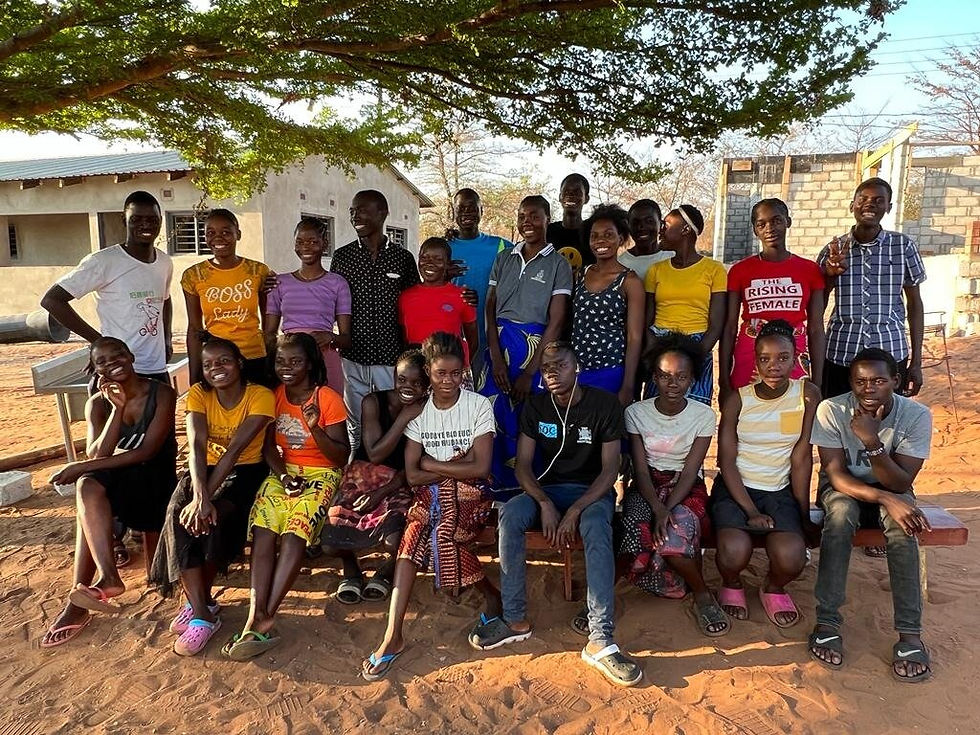
While we were there in March, we bought paint so the students could inscribe their values (see above) at the front door of the youth-friendly space, and John and Pat Ward, friends who accompanied us and fervent supporters of Tonga Teen Corners, bought microphones and speakers so that our student leaders could expand their outreach activities. At Simonga—now boasting a staff of 8 people, including a new physician’s assistant who also supports youth engagement—students are rallying to peer advisors, who take calls by cellphone and in person, and who act as compelling role models for younger members of the community.
But we also saw clearly in March that when the youth-friendly centers function properly, there is a natural and laudable rise in expectations on the part of students who benefit from them in terms of what they can expect from and accomplish in their own lives. While Zambia is exemplary in guaranteeing a high school education to every Zambian and significant scholarship aid for college to those students with strong academic records, most students cannot afford the balance of the tuition, the lodging, food, books and travel that tertiary education would require. It is not surprising—and indeed deeply gratifying-- that many of our student leaders, after volunteering for two years in the youth center and gaining significant leadership experience naturally want to go to university and continue their studies. We did the math and found the figures encouraging: we could send a student who already had a 50% government stipend to college (with the complementary tuition, room, board, books, computer and travel all included) for about $1600 a year.
Accordingly, this past summer we expanded Tonga Teen Corner’s mission and rewrote our founding by-laws to include financing—where our budget permitted it---some training and special certificate learning, and in some exceptional cases, even university degrees for a few student leaders with exemplary records. Our first sponsored student, Boyd Nyunda, former president of our first youth-friendly space at Simonga, is at university in Lusaka this year pursuing an engineering degree. He’s in costume on the left below acting as a village elder in one of the Simonga’ youth center’s outreach campaigns in remote communities. Here, our peer ambassadors are persuading a nearby village to abandon cultural traditions that put young girls in danger of early marriages and pregnancies, as well as school leaving.

We are also opening discussions with the director of Livingstone Hospital about administering a program we would fund for student nurses. More on these new initiatives in reports to come. Suffice it to say that these new efforts are the logical outcome of the powerful impact of keeping students in school, reducing youth pregnancies and sexually-transmitted diseases, addressing addictive behaviors, and modeling “a positive life” by sharing knowledge amongst youth. They have grown naturally from our mission to combine education and public health as our NGO expands and grows and gains experience—in short, our aim is to promote education as a lever of public health, and then subsequently uphold education as the outcome of sound public health.
An Even More Ambitious Program for 2026
This calendar year On Call Africa will begin a major renovation of one of most remote, densely populated, overextended clinics in Choma, Zambia, at the explicit request of the Ministry of Health. Choma is the provincial capital of the Southern Province of Zambia, where healthcare provision for rural communities is very low, but the potential for government investment is very high. This alone makes Botaka strategic, but the facility also serves 23,000 people, about double served by the Chidi facility. This new renovation of a vastly larger and more dilapidated clinic has required immense planning and forethought. It will be a more difficult renovation, larger and more ambitious in size and reach of services than anything we have done before in partnership with OCA. Once that space is completed, a second remote clinic in Choma, called Mubuya, will also be renovated in 2026. You can see the two sites in Choma right in the center of the Southern District below.

Our very ambitious aim this year is to fund the youth-friendly spaces in both clinics from soup to nuts—that is from infrastructure to furnishings, youth engagement and training of community volunteers, project coordination and monitoring and evaluation of attainment of objectives. Both will come in at a cost of about $17, 000 each for multiple reasons—increased size of the beneficiary population, increased size of the clinic structure, state of the buildings, rapid inflation at 12% and subsequent increase in cost of building materials, as well as the decline in value of the Zambia Kwacha against the dollar. For all these reasons, we intend to make the extra effort to raise $34,000 this year for the two new sites, of which about $22,000 have already been pledged.
Here’s where you, beloved friends and family, come in. We need you more than ever….
We hope you will consider making another, or a first, donation at this moment of great promise for our On Call/Tonga Teen Corners collaboration and expanding commitment of the Zambian Ministry of Health.
Our work is ever more important this year because the dismantling of the US Agency for International Development (USAID) is already causing huge repercussions in all African countries, including Zambia. The resultant budget cuts have forced sudden closings of many prevention and treatment programs across Africa. Our NGO on the ground works in isolated areas with vulnerable adolescents, providing educational programs and prevention of sexually transmitted diseases. And we can already see the importance of our mission increasing, even as our workload becomes more demanding in the face of diminished access to treatment.
Every penny/centime we raised with you last year went directly to the building expenses and the training of peer ambassadors who staff them; everything else we do, including our trips and time there, are strictly volunteer.
We hope you will share our enthusiasm for this work and join us in giving whatever amount to Tonga Teen Corners feels right to you. Small amounts go an enormous distance, so please don’t feel that any gift is too small. We are grateful for every single contribution and if you can’t make your gift before the end of 2025 or want to take your tax deduction in 2026, we can receive gifts well into the new year.
Our gratitude to each of you—and that of our 27 teen ambassadors in Simonga, and the 24 trained at Chidi, the 20 who will soon lead the center at Mapatizya, and all of those who will next year staff the youth-friendly spaces in Botoka and Mubuyu, reaching out, each of them, to youth in the villages that surround them—knows no bounds. Please be part of this multiplier effect with us.
We thank you from the bottom of our hearts for your support and belief in our project for its immense and immeasurable impact on the lives of those Tonga teens it touches.