


Trip 1: Our First Assessment Visit to Zambia in 2022
- Sep 19, 2022
- 4 min read
Updated: May 10
From Celeste Schenck, Dominique Delor and Anne Thomasset
The inspiration for founding an NGO in the Southern Province in Zambia was an everyday conversation at our friends Emma and Charles Stewart’s home in Provence a few months before I retired from The American University of Paris and Dominique retired from his lifelong work in French public health. As each of us talked about the “purpose” we hoped to find in retirement, Dominique spoke about his lifelong desire to do humanitarian work, even as he directed three departments’ public health systems in France, and Charles his wish to return to Zambia where he was born to have impact on the communities he so loved as a child. As he put it:
"There is little there in terms of infrastructure; everything is to be built."
Each of them had tears in their eyes as they evoked these complementary projects and the conversation ended with a decision to go to Zambia together in September 2022.
What we hoped to do, Dominique and Celeste, was to combine our passions for education and public health in a project that would sustain us in our retirement years and allow each of us to feel we were continuing to be useful to others. We quickly brought Dom’s old friend Anne, who had spent her childhood in six African countries, into the project. A veteran even then of some 15 humanitarian trips to Africa, Anne was an accomplished pharmacist who had worked at the highest levels of public health in France.
Our first trip, during which we spent over a month in Africa in the delightful, ramshackle house on Charles’s property on the Zambezi, was an eye opener. Simonga, our first village, was only a few kilometers from his property about 18 kilometers from Livingstone in the Southern Province. While the clinic in those days was functional, it was barely built to code, was badly dilapidated, and had no latrines, no solar power and no running water.

Simonga Village was, in 2022, a rural community where the villagers grew sorghum and sweet potatoes, or raised cows, goats, chickens and donkeys. Many of the villagers lived in mud huts made of mud and thatch with rough tree trunks as beams. There was a slow move in the community to build houses out of more modern materials.
Founded in 1958, the village was home to about 4,000 people, predominantly of the Lozi tribe, one of Zambia’s 73 tribal groups, even though the territory itself was largely Tonga and many people spoke that dialect. There was no plumbing at all, very limited electricity, and no Western-style medical services to speak of.

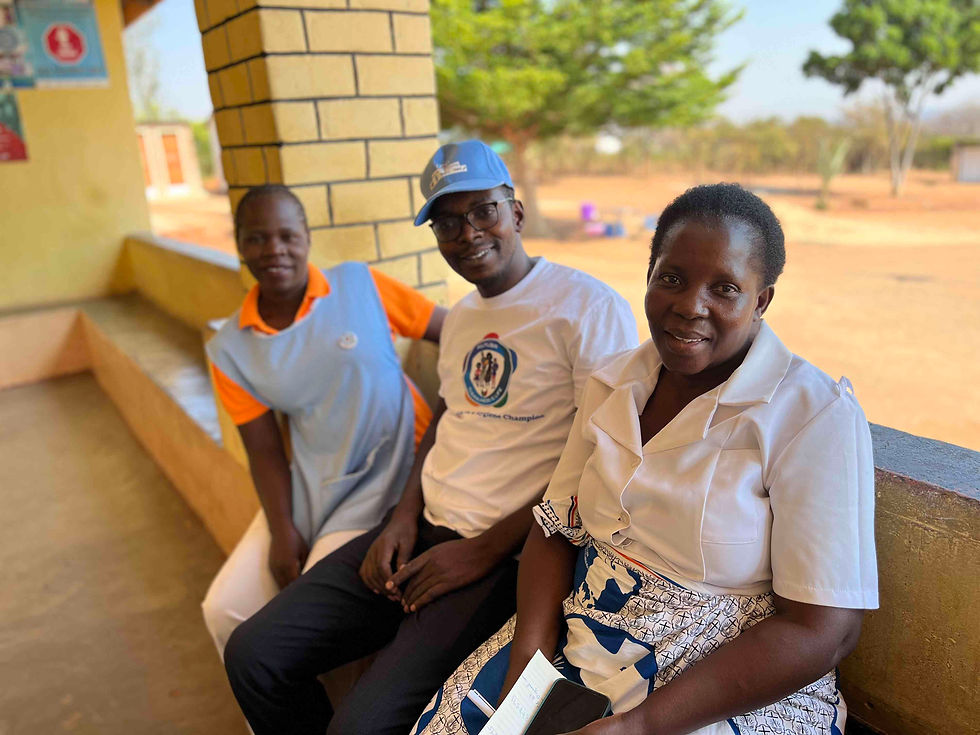
The village had at the time a small three room clinic, staffed by three heroic nurses assigned to the village by the Ministry of Health. There was no doctor in the village and no easy access to hospitals in Livingstone. Healthcare was free (considered a human right in Zambia) to the villagers, after a small fee had been paid for their “notebook” (medical record). The average life expectancy at the time was about 37 years! Care was basic, although an outreach program provided anti-malaria tablets, sleeping nets for pregnant women, and subsidized sleeping nets for everyone else. Simonga was, by chance, located near several lodges along the Zambezi River above the falls, and a few of those lodges had adopted the village by providing access to water, school supplies, and books, and by digging wells and building a police post. Clean water, despite the daily pumping of 100,000 litres a day from the Zambezi by a local lodge, remained a constant issue. Many of the villagers still went to the traditional medicine healer who prescribed herbs from her hut.
But as we dug deeper, met with local authorities, read the health promotion vision of the Zambian Ministry of Health, talked to the mayor of Livingstone, and the doctor directing the Livingstone District Health Office, we began to see the lines of a smart, prevention-focused public health system emerging in Zambia in spite of the huge needs, especially in rural areas, and the current state of infrastructure everywhere. HH, the recently elected new president, very pro-democracy and anti-corruption, focused on education and health care as soon as he took office, hiring 30,000 health care workers country wide.
As we read and understood the vision for public health, it would focus on prevention, on “health promotion” or education about health, and it would particularly emphasize the health of youth under the age of 30, which made up 70% of the population of the country. We also gained great respect for the professional training of nurses in Simonga, many of whom take on the responsibilities of doctors, caring for everything from chronic illnesses to HIV. The nurses at Simonga, in short, convinced us from the outset that they were highly deserving of support and willing partners in the work. We resolved to find a way to help construct the youth-friendly spaces envisioned in the Zambian health plan and to work with young people via leadership training and support.

Through our friends Emma and Charles, we met with several of the program officers of a British NGO in Zambia known as On Call Africa, and realized that separately we had come to the same conclusions. On Call, like our fledgling NGO Tonga Teen Corners (named by Anne’s grandchildren), first believed that an influx of foreign doctors would support medical care in rural areas. It had for a decade brought young and retired foreign doctors to Zambia to support local clinics. But it had come to the same conclusion we had: that the intermittent presence of foreign doctors had the opposite effect, often disempowering local nurses rather than strengthening health care in rural milieux. It had recently, through a strategic planning and assessment process, decided to refocus its efforts on strengthening infrastructure in rural medical settings, working hand-in-glove with local authorities and handing off the renovated clinics to a government capable of staffing and maintaining them.
We joined this effort with a pledge to build one youth-friendly space a year.
Tonga Teen Corners was born.


