


Trip 4: What Two Youth Corners Can Set in Motion
- Mar 24, 2025
- 10 min read
Updated: May 8
From Celeste Schenck, Dominique Delor and Anne Thomasset
Our landing in Zambia this year was a flurry of late flights, layovers, and then a jump straight into the rapids. By the next afternoon following our landing in Livingstone we were already back at our first site, Simonga Village, checking in with our student leaders and trying to take in what has changed since we first began this work. We want to begin, as always, by saying how grateful we are to each of you for helping us build a project that has such a hold over our hearts. We will share images and stories from the next two weeks as we do each year.
Simonga, Handed Over and Fully Lived In
At Simonga, the teen corner has now been officially handed off to the village. What that means in concrete terms is that On Call Africa sets a boundary when it lifts a health post into a center. From the moment that the reconstruction of infrastructure has been achieved, the center is handed over to the local District Health Office which assumes full responsibility for its maintenance and upkeep through community engagement, full staffing to the limits of the law, and full provisioning of its equipment and medication needs. We are involved in bringing the center to code, but the government and the community assume all responsibility henceforth. Otherwise, there is a continual expectation that On Call and its partners will do upkeep even as we’ve moved on to renovation of other centers. To date, this handoff is working and boundaries are being respected.
Boyd and Loveness are leading student engagement at the Simonga Center, as president and vice-president of the youth-friendly space. Melody, the head nurse, called Queen Mum with great respect by virtually everyone there, calls him her indispensable “little husband,” so thoroughly has Boyd shown leadership of the center. Where Miriam had been the nurse in charge of the youth facility to date, Boyd is this year supported by a new employee at the center, Stephen, a young physician’s assistant who has the confidence of the group.
The peer ambassadors’ work is mushrooming to include visits to schools, to even more rural villages than their own, even to mobile consultations with young people who can’t get to the center. There are zones of Simonga village up to 20 kilometers from the health center, which means those young people cannot get easily to the youth-friendly space, no matter how desperately they need knowledge and help.

When the peer ambassadors can find loaned transportation–via a local school or an eco-lodge willing to share a vehicle–they pack up their instruments and costumes and go themselves. When they can’t, they consult with their peers via a few mobile phones shared amongst villagers and youth. We were blown away by the methods they devise to share their knowledge with their peers: texting responses to questions they receive from beleaguered teens in the most rural outposts.
Boyd and Loveness stood under the logo and motto, tuyeyele antomwe, which we translated on site as “let us combine our knowledge for the collective.” It was a simple moment, but it carried the weight of what this space was meant to be: a place where knowledge can circulate safely and where young people can reach each other.
A Health Post Becomes a Health Center
This visit also made visible the larger transformation around the teen corner. Simonga has been upgraded from a medical post to a center because it now meets every one of the six criteria required by the government. We were thrilled to see the next step in that process: “as soon as a health post is upgraded by the intervention of donors and NGOs, the government provides the personnel.” When we first arrived, Simonga had three nurses who did everything. Today, they have eight employees, housed close by, including another nurse, a physician’s assistant, a psycho-social counselor (whom TTC sponsored to earn his certificate), and several health workers.
Simonga is now considered a center of excellence, where young doctors from the medical school in Livingstone and Lusaka come to see what rural medical care can look like.

What the Team Still Needs
Our discussion with the nurses and peer educators produced a clear wish list. The adolescents still wanted to paint the list of their values on the side of the youth-friendly space, along with a list of services they provide. We also analyzed what was missing in the youth-friendly space, notably electricity, internet, and enough security to place the TV and computer where they could be used easily. Distance remains a stubborn barrier. The team spoke openly about how difficult it is to do outreach to bush villages due to long distances and lack of reliable transportation.
What we could solve immediately was practical. The student leaders needed a cordless speaker and microphones so that when they go into villages they can call people to the village center for plays and dances. Later that week, our friends and generous donors, Pat and John, gifted the Simonga leaders a portable cordless speaker and two cordless microphones for their monthly outreach projects, and we brought paint and brushes so they could continue making the space their own.

Internet, which would make all the difference in these centers, requires a maintenance commitment which is difficult for us to make given On Call’s boundary agreement with the District Health Offices. We could easily include the equipment in our list of furnishings, but the annual fee for maintaining internet service would need to be borne by the community and/or the district offices; the cost remains prohibitive for both.
Human Rights, Education, and a School Assembly
Boyd has taken to writing poetry, and during this trip he shared a poem he wrote on human rights. In Zambia, he told us, health is a human right which children are taught from nursery school on. Early one morning we went to a grammar school in Simonga where children were performing Boyd’s poem. Boyd and Loveness had worked with them on uman rights issues, and the students performed songs at assembly about education and their rights.
Our friend Pat, a veteran teacher, was struck by the importance of education in Zambian culture and by the involvement of parents in their children’s learning. We have never been in a rural village in Zambia that does not have its own brightly painted school at the center. She also noted the children’s joy in learning and the teachers’ joy in teaching. The school itself raises money for breakfast and lunch so that children do not have to learn on an empty stomach.
Working With On Call Africa, and Planning What Comes Next

The most important work of the trip took place in meetings with On Call Africa over the training of peer ambassadors/educators and plans for the future. We spent a morning with the team in their Livingstone office, hearing about the evolution of their mission and making joint plans for next year. For the first three years, our main contacts at On Call included the CEO Ben in England and program staff based in the US and UK. In 2024, On Call implemented its vision for turning the organization over to an all-Zambian team, including a new CEO, Nkandu. This was our first opportunity to interact with the entire new team and to hear from them how On Call’s Zambian and global strategies had evolved, as well as to get a sense of how well this group of relatively young people interacted as a team.

We left these meetings buoyed by the professionalism of this new team and its expanded vision for a strengthened rural health program in Zambia and elsewhere. As we wrote to all of you from the porch that evening: “Your generosity means the world to us and to the people we work with here.”
A Full Day in the Field: Chidi, Then Mapatizya
On one long field day with On Call staff, we returned to Chidi, the second site we funded last year, and visited Mapatizya, the third site we plan to support this coming year.

Chidi last year could be described in stark terms. At Chidi, 11,000 people depended on one resilient middle-aged male nurse; the hospital was 70 km away over frequently impassable roads; the community had access to exactly one ambulance which was often out of commission. That meant that emergencies rarely got the care they so desperately required. A year later, we saw a transformed complex: a renovated clinic with wards for men and women, new spaces for pregnant women awaiting childbirth, a new maternity clinic, a new “travelling system” of ultrasound for pregnant women that was delivered by mobile phone and a red motorized tricycle that could get to the most rural outposts, new solar and water, and the youth-friendly space itself equipped with solar and Starlink, plus the TV and computer we provided. It is now home to about 35 peer educators who have been trained and assigned to the nine zones around Chidi. The peer ambassadors told us they go into remote communities equipped with kits that include blood pressure monitors, thermometers, testing kits and other tools.





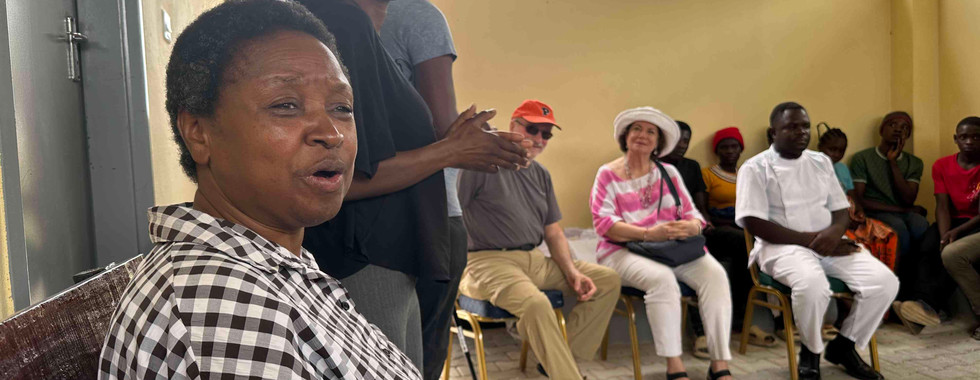


We also saw evidence of the way On Call’s approach has matured. In Chidi On Call staff involved the government, the District Health Office, from the very start, and it was the District, not On Call, that provided most of the training to peer ambassadors and the community-based volunteers that support the clinic’s operations. The intent is clear to all. On Call provides infrastructure to upgrade clinics, and the District takes responsibility for maintenance and upkeep, ensuring community ownership. We also learned on this trip that several issues we’d highlighted on earlier visits within the youth-friendly spaces were being addressed. The result would be a complete redesign of the space in all future building projects (greater security, addition of windows, fitting out of examination rooms within the space, provision of locked cabinets also within the space stocked with contraception, treatments for STIs and morning-after pills). Increasingly, nursing staff come to the youth-friendly space when called by peer ambassadors to deliver care.

From there we went to Mapatizya. The road itself was part of the story, and the day stretched to more than 13 hours from start to finish. At the Mapatizya site, we saw the clinic where we will be adding a youth-friendly space this year. We spoke with local authorities about their needs while the roof was falling in around us. The need for renovation was not theoretical at Mapatizya.
This particular outpost faces special needs–a yearly influx of Zimbabwean workers, who, living far from their families, staff the nearby mines. The rising numbers of STIs and teen pregnancy under conditions of such transience, drought, poverty, and food insecurity were troubling to all.
Livingstone Hospital: A Possible Next Educational Step
The morning after, we went to Livingstone Hospital, where we met with the director and began early discussions about partnering with the Hospital’s College of Nursing to sponsor student nurses. Livingstone Hospital has both a medical and a nursing school, and the director spoke openly about the challenges of maintaining and replacing diagnostic equipment. We discussed the practical costs of sponsorship, including tuition, room and board, transportation, and supplies. The estimate shared in our update was that it would cost in the neighborhood of 750 USD a year (tuition, room and board) for three years to sponsor a nursing student.
An Outreach Visit With the Peer Educators
After lunch, we accompanied the peer educators of Simonga on one of their outreach visits, something we consider crucial to the life of the teen corner. Transportation was, as always, the hardest part. A local lodge had planned to share its bus but withdrew at the last minute, so a local school principal rented us his school bus. En route, we hit a pothole and got a flat tire, and the jack we had was useless. A Good Samaritan stopped and changed the tire with proper tools.

Once in the village square, thanks to the drumming (and the new cordless amp and mics), first came the children, then the adolescents, then the mothers, and then the men and elders. The subject of the outreach that day was ending teen pregnancies. The peer educators put on community theater to dramatize what they were trying to convey. After the performance, they dialogued respectfully with elders, calling them Auntie and Uncle. We were very moved by the response of community members. One old man said to the peer ambassadors acting in the play:
“We wished our own parents had talked to us as you do today. We want to talk the way you do to our children and grandchildren.”
Many adults then stepped forward, men and women, to say that girls should stay in school and be educated rather than become mothers too early. Seeing the community itself choosing to abandon harmful cultural traditions–out of deep respect on the part of its youth to its elders, and vice versa–was one of the most meaningful experiences we have had in Zambia to date and was the most compelling evidence we have seen of the importance and impact of our youth-friendly spaces.





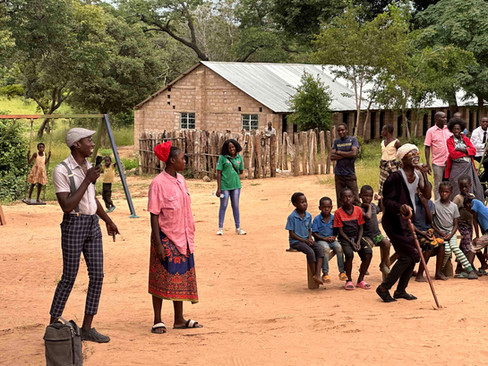


We also witnessed smaller moments of care. We met a boy who had walked many kilometers to Simonga to join the peer educator group and would now be supported by the youth center. We met another boy, an albino whose eyes had been burned by the sun, who could barely see. Dominique had brought wraparound sunglasses and gave them to him, to protect his eyes.
International Youth Day in Simonga
The week’s culminating community event was International Youth Day in Simonga. Preparation took a full day of shopping with the young leaders, who insisted on the lowest prices and best quality, and then a full program led by Boyd. He began with a speech telling young people they have a voice in Simonga and that their ideas for improving community life are important and will be listened to.
There was drumming in costume, plays, dances from different regions (Losi and Tonga predominantly), and games that pulled children into the circle. Stephen, the physician’s assistant, made a story about leadership out of a game. At nightfall, the nurses cooked an evening meal, and Boyd thoughtfully set up a hand-washing station and arranged a table in the clinic waiting area so we could watch the sunset over the Zambezi.
In the final moments, the young people explained they had borrowed drums to have enough for the celebration, and we agreed to go drum shopping the next morning. We found three used drums with the help of our friend John, a musician himself.
Closing Notes From the Road
As we prepared to leave, we learned something unexpected and meaningful. After visiting the new Honorary Consulate of France in Livingstone and holding a Zoom call with the French Embassy in Lusaka, we were told that Tonga Teen Corners is the only French NGO in Zambia. We also shared with you our sorrow at what we called “the cruel withdrawal of USAID from Africa,” which we wrote has already begun to be felt. In the Simonga pharmacy as we left Zambia, just two months after Trump had taken office, the box of HIV treatment medications was nearly empty.
We end as we began, with thanks.
We are exhilarated by the progress, but the work is truly theirs: On Call Africa, the nurses, and the young people themselves. We provide means, partnership, and some guidance. The beautiful work of changing hearts and minds is theirs.
A million thanks to each of you for being believers.


