


Trip 2: Building a First Youth-Friendly Space in Simonga in 2023
- Mar 20, 2023
- 8 min read
Updated: May 10
From Celeste Schenck, Dominique Delor and Anne Thomasset
On our second trip to Zambia, we returned to Simonga Village, about 18 kilometers from Livingstone, with a single, clear goal: to open our first teen corner, a youth-friendly space attached to the rural medical clinic. Many of you had already supported this work generously, so we wanted to bring you along, not with a polished report, but with what it feels like on the ground as a building rises and a community prepares to claim it.
Our dear friends Charles and Emma, who first inspired us to come to Zambia, welcomed us again as hosts and companions. And the young people of Simonga welcomed us back with traditional dances, drumming, and plays with social messages about how to seek support for good health and sexual matters. What a remarkable experience it was to sit in the sunshine outside the clinic and see them perform, as they do when they conduct outreach visits, showing such respect for traditional culture even as they are asking their peers, and their elders, to consider changing their attitudes toward some aspects of it.
Meeting Our Partners and Aligning the Work

Early in the trip, we met with our partners at On Call Africa, the local NGO with whom we had worked over the past year, and with whom we had signed a Memorandum of Understanding. Our work with On Call Africa stemmed from our mutual discovery, virtually at the same time, that bringing foreign doctors to work periodically in these rural clinics would not strengthen them, but would more likely weaken the community’s trust in local caregivers and nurses. Instead, we resolved to find ways to build capacity by supporting the Zambian Ministry’s vision for public health.
Together, we went to the District Health Office to meet the new director. We left those meetings with a shared understanding of goals and expectations, and with deep gratitude for what it means to return a year later and see how Simonga’s hopes for its new medical center are taking shape.
The nurses of Simonga and the center they are building
We spent time with the core clinic team who hold this place together: Melody, the head nurse, and Samuel and Miriam, who are married and work side by side. These three nurses treat everything from emergencies to deliveries for a village catch basin of some 6,000 people! They spoke of their dream of making health care ever more accessible to the people in the village and its outposts, and of reaching adolescents more effectively through a dedicated teen space. We found them nothing short of heroic, diagnosing and treating everything from chronic lifestyle illnesses to HIV, often carrying responsibilities that would be divided amongst many more staff in most settings. To these nurses in rural medical posts are delegated many of the responsibilities normally assumed by a doctor.
Their commitment is part of why the teen corner matters. It is not separate from the clinic’s work, but an extension of it: a space designed so adolescents can seek information and services without shame. Most important of all, prevention undergirds all health care in Zambia. Even in the most rural, underserved clinic, the walls are lined with notebooks archiving every community member’s health care. There are designated days for post-natal and under-five care, family planning, etc. during which women and children–and now adolescents–can gather to learn in groups about how to care proactively for their health.
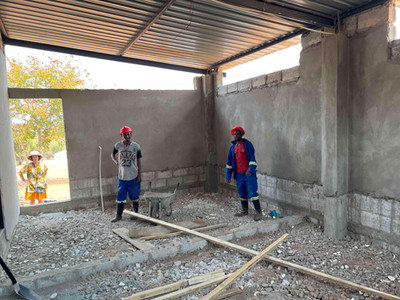
Back at the site, the teen space was visibly advancing, day by day. Walls rose, then a roof. The sense that something permanent was being built–not only a dedicated space, but a new kind of welcome for adolescents, free of stigma and judgment–became more tangible with each visit.




Prevention Requires Tools: Condoms, Training Models, and Plain Talk
One of our most practical conversations, and one of the most urgent, centered on condoms. Everyone agreed on the critical need to make condoms free and readily available to all youth through the teen corner, both for contraception and for protection from sexually transmitted infections. The nurses explained something equally important: access is not enough without education. To teach adolescents how to use condoms properly, the clinic needed anatomically correct teaching models.
That need led to one of the most vivid mornings of the trip. We met extensively with the District Health Office point person for adolescent health, Beatrice, a young nurse whose matter-of-fact positivity charmed us completely. In her office closet she had only two anatomical models, carved out of local wood, to serve the entire adolescent population of Livingstone. She then marched us to the market, with those models in a shopping bag, to commission sturdy male and female teaching models from a local carver. When the experienced wood carver looked into the ShopRite bag he nearly fainted. But under her expert tutelage, prices were nonetheless negotiated; a sample was ordered; laughter rang out throughout the morning, and we left with a plan to procure by the end of our visit enough models both for Simonga and for Beatrice’s own clinic.

Beatrice also told us something sobering: not a single center in the Southern Province, at that time, met health code standards for youth-friendly spaces. She compiled the list of requirements, and we used it as a guide. By adhering to the Zambian Ministry of Health’s vision, Simonga would be the first youth-friendly space to meet the standard, with separate, confidential quarters, special signage, consultation rooms, and a large, well-equipped meeting room. That is what it means, in concrete terms, to build a “center of excellence.”
Simonga’s Teen Ambassadors: Leadership, Values, and a Motto
We met for two hours with the adolescents who are at the center of everything, about twenty young people who could not wait for “their” center to be built and who would serve as peer ambassadors in their community. Their maturity, articulateness, and knowledge stunned us. They spoke with deep responsibility about friends and family members suffering from addiction, and about early marriage and pregnancy. They asked how young people in France get information about sexuality, and we spoke honestly about the distortions of social media. Their own method is direct and person-to-person, mainly through community engagement.

Over the course of the trip we had planned to begin soft leadership training, but they were more than ready. They brainstormed their space’s identity and language, producing a design for posters and peer ambassador t-shirts, choosing words in Tonga–tuyelele antomnwe– that they translated as “let’s reason together for the good of all.” Even the logo points to the beating heart of community at the center of their lives.

At another gathering with us, they named the values they hoped to honor in their community service: respect for self and others, capacity-building, kindness, confidentiality, trust, self-control, cooperation and solidarity, living a positive life, sharing, and putting their knowledge together. They planned to paint these values, along with the logo and the motto they devised on the walls of the teen corner.
They also spoke with a seriousness that deserves to be heard publicly: boys discussed gender identity and gender-based violence, the need for women in leadership, and the importance of reporting abuse regardless of gender. They talked about existing resources, including one-stop support services for violence that combine medical, legal, and other forms of help, and the way rural centers can call for transport for victims. It was a powerful reminder that Zambia, while facing deep challenges, is also building systems and language for dignity and care. Ending gender-based violence is a political goal that is visible everywhere.
Taking the Message Beyond the Clinic
The teen ambassadors were not content to wait for a building to open. They already used drums, plays, and public performances to engage peers and their elders in sub-villages beyond the health post, building a sense of belonging before turning toward health messages. During this trip, we attended a large meeting at the Simonga public school where one of the nurses introduced the aims of the teen corner and the ambassadors put on plays for students, with speeches and call-and-response, followed by song, dance, and skits, including a demonstration of how young women can and must feel confident saying “no” to men who proposition them.
A Larger Transformation: Simonga’s Upgrade
We also received important news about the broader clinic itself. In a meeting with the mayor of Livingstone and the head of the Simonga village council, we were told that once the renovations to the health post are completed and handed over to the District Health Office, Simonga will meet the standards of a health center and be upgraded as such.

While the government simply hasn’t the means to do the infrastructure renovation–that is the province of numerous NGOs–it does and excellent job of training both nurses and teachers, sending them subsequently to staff the rural centers. The youth-friendly space is one part of this wider renovation of rural health posts, alongside new men’s and women’s wards, a new maternity clinic, a women’s shelter, flushing toilets, a special area for baby and child health, and simple staff quarters. All health posts will be fueled by both solar-generated electricity and clean running water.
Because staff quarters are being added, the upgraded health center is expected to receive two more professional staff members, and possibly even a doctor. We were told this would help ensure that the adolescent space remains open seven days a week. It is hard to overstate what that kind of continuity can mean in rural settings.
Opening Night: Painting, T-Shirts, Food, and Community
As the opening of the youth-friendly space approached, the work became both logistical and ceremonial. We had printed the peer ambassador t-shirts the adolescents had designed, and the large cakes carrying the logo and motto. We gathered as the sun set in Simonga on the last Thursday evening of our trip with adolescents who had to obtain permission from their parents to stay out after dark. Kaso, the talented youth coordinator from On Call Africa, led warm-up exercises with the group, and then the wall painting began as the youth claimed their space. Dances and a play accompanied the ritual, as always happens during these community gatherings.




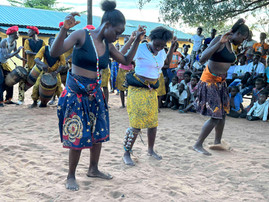


A meal followed, and then the adolescents painted the walls of the teen corner in the blue and orange colors of their logo. Even Dominique took a turn at the wall. The peer ambassadors received their t-shirts with pride. The cakes, cut into dozens of pieces, disappeared quickly, and we watched something deeply moving: the adolescents stood back and let the younger children go first, lining up, encouraging one another, never taking more than their share. The sense of community here is bedrock.
We were also touched by the presence of Papytcho, an anesthesiologist from the Republic of Congo whom we had met on our first visit and who has helped secure hospital appointments for villagers whose needs exceed the clinic’s capacity. The only anesthesiologist at the Livingstone Hospital, he surprised us by arriving for the celebration.
What Comes Next
As we left Livingstone this year, the teen corner was still unfolding into its next phase of life. Messages were already coming in from adolescents and nurses about what should happen next. When we return mid-March, en route to Madagascar, the plan is for the space to be fully fitted out with games, computers, and other supports that invite young people into a healthy community after school, along with rapid test strips, a staff member to counsel young people, and confidential access to medical services, including contraception and STI treatment.

On this trip, as a result of consultations with staff at On Call Africa, we learned that our partner NGO has resolved to renovate clinics that are farthest from hospitals and thus the most rural and in need in the Southern Province. We heartily agreed with this strategy and pledged to support the work in Chidi, in the very rural areas of Zimba, a far-flung district within the province. It will take ten hours on a dirt road to get there and back from Livingstone.
We remain deeply grateful to all of you who listen, support, and help make this work possible.


