


Trip 5: Half a Decade in Zambia: New Sites, Stronger Systems and Clear Evidence in 2026
Updated: May 6
From Celeste Schenck, Dominique Delor and Anne Thomasset
We arrived in Zambia for our fifth year with a sense of relief we could feel in our bodies. After last year’s drought and its daily consequences, it was a gift to see the landscape green again, crops thriving, the Zambezi high, and electricity steady enough to let plans unfold without constant improvisation.
This year, Dom, Anne, and I were joined by dear friends from the Luberon, Noëlle and Joël Canat, who share our interest in education and public health in Africa. As always, we were also accompanied by the steady presence of our partner NGO, On Call Africa, whose dedicated young team makes it possible for these youth-friendly spaces to exist at all.
A New District, a New Site, and a Hard Lesson in Scale
With our second and third centers finished at Chidi and Mapatizya, we traveled early in the trip with our colleagues from On Call Africa to Mabuyu in Kalomo, a new district for us north of Livingstone on the road to Lusaka. The District Health Office, On Call Staff explained, had requested that we renovate next a series of posts in Kalomo that were woefully under-staffed and over-subscribed. Nothing we have renovated to date has catch basins as immense as those in the Kalomo area. The district is deeply remote, with a population of about 300,000 and 36 small medical posts. The journey itself felt comparatively manageable by our standards, about five hours round-trip, including highway and then dirt tracks. But nothing prepared us for the conditions at the post we visited.

The Mabuyu clinic is a crumbling prefabricated structure with a leaking roof and only three small rooms of roughly 15 cubic meters each. One male nurse, assisted by two clinic officers who also provide part-time nursing support, cares for a community of 10,000, including all births. There is no running water. Water is carried from a well about 100 meters away. Electricity is inconsistent and comes from a single solar panel. The space is infinitely worse than that of Chidi a year ago, especially given the huge number of people it serves.
Space is so constrained that the waiting room holds about twenty people, but when a pregnant woman arrives for an examination, everyone waiting is asked to step outside to create minimal privacy. The third room functions simultaneously as office, examination area, and intake space, separated only by a bedsheet hanging as a partition. On the day of our visit, roughly thirty young mothers came for antenatal care and infant vaccinations. With no room inside, they gathered under a nearby tree in the heat for teaching and services.
We were told that about 1,000 patients pass through this post each month. The only reason it functions at all is that community members step in to help with key tasks, including taking histories, testing, and offering support during births. As we have come to expect in Zambia, what astonished us again was not only the endurance, but the rigorous organization of these rural posts: protocols posted on the walls, carefully kept notebooks for each patient, and a weekly cycle of services organized by day.
Simonga: A Health Center, a Larger Team, and a Youth Space That Works
A few days later, the rains returned. They ran longer into March than we remember, and we felt again what those cooling rains mean for corn, for mealie-meal, and for daily life. The rains also meant that we saw few animals this visit as they have no need to come to the river in search of water; they do not come into town in search of food. The rains also meant that for the first time in five years we could not see Victoria Falls, given the volume of water rising into the air after it dropped into the gorge.

On Thursday we went to Simonga, about 20 kilometers from Livingstone, and spent the afternoon with the team we have come to know well: Melody, Miriam and Samuel, Prudence, and Stephen backed up by over forty community-based volunteers and 21 peer ambassadors in the youth space. Over the years, our growing friendship has become part of the project’s backbone.

We brought Stephen his own stethoscope, along with blood pressure machines, bandages, and clothing for mothers and babies. Anne’s second suitcase, as always, was packed with medical equipment and supplies donated through family ties to hospital medicine. We were happy to find Simonga in excellent shape: the yard raked, buildings clean, cupboards organized, systems visible even on a day when the clinic was closed for the afternoon because it was Youth Day, a national holiday.
We were relieved to learn that the clinic still had access to high-quality antiretrovirals for HIV. Seemingly the private sector and other providers worldwide have stepped up where USAID has refused any longer to tread. Indeed, while we were there this year, Trump offered the Zambian president an exchange of health care support in exchange for Zambian minerals; the Zambian president elegantly but firmly refused.
Pregnant women whose pregnancies are confirmed are tested systematically and treated if needed before delivery. What the team lacked, unexpectedly, were medications for chronic lifestyle illnesses like hypertension and diabetes, and sufficient injectable antibiotics to treat syphilis. We inventoried those gaps and were able to address them quickly in town, where an Indian generic pharmacy had supplies at a fraction of European cost.
Simonga is now a thriving center, with roughly double the personnel. The catchment zone is now described to us as about 20,000 people, and the clinic welcomes about 30 births a month, almost one a night. Nurses take turns being on call and can be summoned for births after a full day of clinic work. Melody told us that forty community volunteers were expected the next day to clean the clinic area and buildings, and that many volunteers rotate regularly through registration, triage, and support during childbirth. This is one of the quiet strengths of Zambia’s rural public health system: the community does not stand outside it. It holds it up.
Then we stepped into the youth-friendly space. It was, in the simplest and most moving sense, lived in. The students keep it meticulously clean. As older peer educators graduate and move on, younger students train to replace them. Peer educators welcome adolescents at the facility three days a week and organize outreach across the wider zone, reaching villages up to 20 kilometers away. When transportation fails, they walk, carrying drums and costumes.

We also learned something new about how the youth space protects confidentiality. When an adolescent needs care, there are two pathways: either the peer educators call up to the clinic and a nurse comes down to the youth space to examine, treat, and dispense medication or contraceptives, or the adolescent is escorted by a trusted peer around the back of the clinic to receive priority care without standing in the public line. We love how they have found simple but powerful ways to support confidentiality and build trust in the non-judgmental provision of health services to adolescents.
During our visit, the students asked for more women’s costumes for outreach ceremonies, and we plan to meet them in town to buy what they need. We were also reminded of a stark structural reality: a large high school sits only a few hundred meters from the clinic, yet custom and law prevent sex education in schools. At Simonga though, teachers can send students to the youth-friendly space next door. This is one reason the teen corner matters so much. It fills a gap the school cannot legally fill.
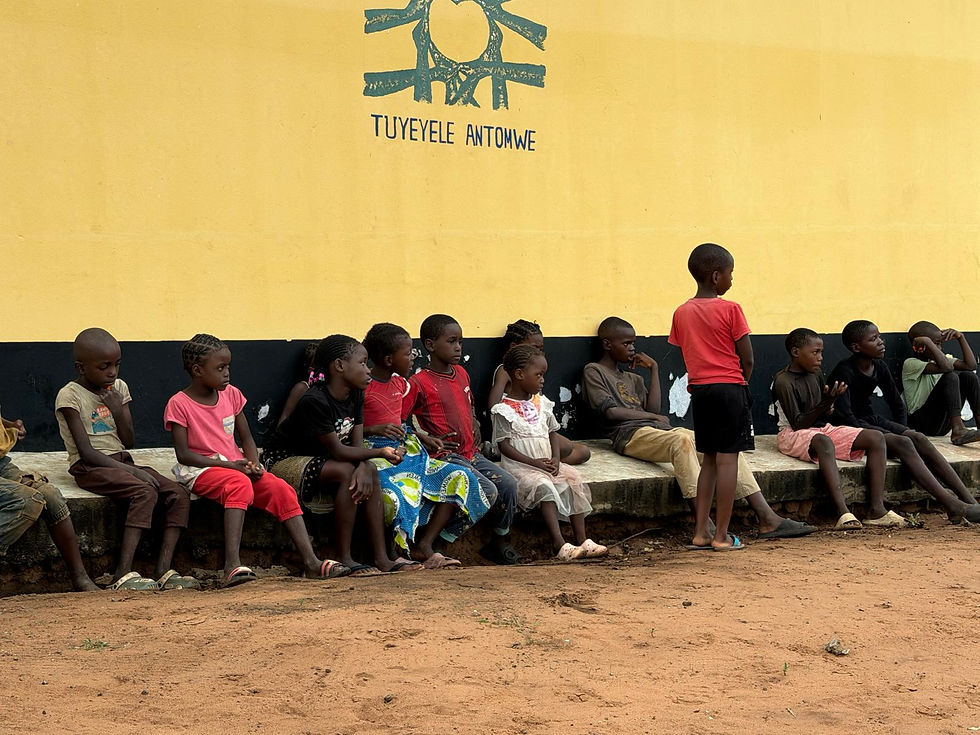
"tuyeyele antomwe or let us put our knowledge together for the good of the community.”
On the inside wall of the clinic, the students have painted their hands in every color on the walls. On the outside wall, the students’ values and their motto remain visible.
The Long Road to Zimba: Chidi and Mapatizya
The pace of this trip to last year’s sites was relentless, in part because the geography is relentless. We undertook for the second time the long round-trip to Zimba district to visit Chidi and Mapatizya, The road is paved only for the first forty-five minutes, after which travel becomes slow, rough, and weather-dependent.

On the way, our On Call partners told us that TTC is the only NGO in Zambia building youth-friendly spaces to the highest specifications of the Ministry of Health and, as they understand it, the only NGO focusing on youth needs in the remotest and least serviced areas. We were also told by the Honorary French Consul, whom we finally met, that TTC is one of only two or three French NGOs in Zambia and the only one in Southern Province. We report these statements as they were shared with us during the visit.

In Chidi, the change from last year was dramatic. The head nurse who had been carrying the work almost alone now has additional staff, including two clinic officers, along with new living quarters. He has a computer and District software enabling him to keep and report statistics and make orders as he needs them. The rebuilt facility painted in the bright trademark ochre colour of rural health centers now includes wards for men and women, examination rooms, a full maternity with separate spaces for pre-delivery, delivery, and post-delivery care, toilets and washing facilities, clean running water from a new well, and electricity, both absent last year. Women also have living quarters where they can stay before delivery for up to four weeks, along with bathrooms and a kitchen to prepare their food.

The nurse shared a statistic that mattered to him and to us. Last year, 41% of pregnancies in Chidi were teenage pregnancies. This year, that figure has dropped to 35%, which he described as an extraordinary change for a first year. Chidi remains second in the district for teenage pregnancies, but he was proud to have moved out of first place. We also learned that the community is building, at its own expense, a kitchen for mothers staying near the clinic before birth.

Chidi’s youth-friendly space is already active. There are 21 peer educators in place, trained and working, and the students have created their own decorations inside, including a tree-of-life with many-colored hands, echoing the painted hands of Simonga. The youth center’s title was neatly stenciled next to the door.
The youth leaders there primarily speak Tonga, so we spoke through a translator. Their operating reality differs from Simonga’s. Simonga sits near a large high school, which makes drop-in participation easier. Chidi’s zone includes seven sub-areas as far as 25 kilometers from the clinic, so youth work happens by dispersing outward, attaching drums, dances, and community theater to larger gatherings across the zone. We are now discussing with On Call whether bicycles should become part of future youth-space provisioning to help peer educators reach the farthest areas, as four-wheel transportation is even more of a problem here than in Simonga.

Chidi has also developed an embedded care model. One consulting room is used for confidential consultation and distribution of contraception, including morning-after pills, while a nurse provides examinations and treatment from within the youth space itself.
Because Chidi’s remoteness limits access to education and employment pathways, skills development is being added. The group we met had traveled to Livingstone for tailoring training on sewing machines and will share those skills back at their center.

Mapatizya is even farther still, about two and a half hours beyond Chidi, near mines and the Zimbabwean border. It is frequented by truck drivers and migrant Zimbabwean mineworkers far from their families, a pattern that has direct implications for reproductive health and teen pregnancy.
The youth space there is our third, redesigned based on learning from the earlier sites. It is more secure, better aerated, and avoids the vulnerabilities of an open-roof design. During this visit it was being painted and finished, prepared for furnishing and handover. We were assured it would be handed to the District Health Office in late April, as work begins simultaneously on Mabuyu and Batoka.
A Simonga Tradition: Dinner, Performances, and a New Generation
On Sunday, the Simonga peer educators invited us to a party and dinner, one of our annual traditions with them and the nurses. As always, the students performed. What moved us this year was seeing a new cohort stepping forward, drummers and dancers replacing those who have graduated and moved into work or further study. Each year the group renews itself, and each year it becomes clear that the center’s continuity depends not only on a building, but on leadership passing from one set of capable hands to the next.
Conard, the current president of the Simonga youth space, is an exceptional dancer. His family comes from the East, and his costume and dance are Lozi. Children watched from the sidelines, spellbound.
Livingstone Hospital: A Nursing Scholarship Program Taking Shape
We were up early the next morning to meet colleagues at Livingstone Hospital, including its wonderful, soft-spoken yet ambitious director. Anne brought surgical dressings and broad-spectrum antibiotics from France, which the hospital pharmacist was glad to receive.

We visited the College of Nursing, which offers seven different pathways and specialties, to explore a scholarship program for local high school graduates to earn RN degrees. The hospital subsidizes heavily and provides room and board as part of the package. The estimate shared during the trip was $750 per year for three years to sponsor one nursing student. We also discussed a likely first candidate: the first vice president of the Simonga youth space, a young woman who hopes to become a nurse. Over time, we hope to offer nursing sponsorship as a structured extension of TTC’s commitment to rural public health.
Education on Display: Conard’s Student Teaching

Invited by Conard, we also visited the oldest high school in Livingstone, built in 1963, a year before independence and later rebuilt by the World Bank in the 1980s. It educated nearly 2,000 students per year. Conard was there completing his student-teaching requirements for the David Livingstone College of Education in Livingstone.
It was a source of tremendous pride to us to see him in a classroom, stepping into a role that carries its own kind of influence. As he confided to us later, he was a strong science student and would have preferred to go to medical school in Lusaka, but the cost of attending seven years of medical school far from home for the sixth of eight children was prohibitive.

Evidence at Last: Six-Month Results From Chidi
At our wonderful farewell lunch with the On Call Africa team, we learned about a significant development. On Call has created a new impact team of three young Zambians with MA degrees in Development Studies. Using verified Ministry of Health statistics compiled at rural medical posts through a government software package, they have begun baseline studies and six-month follow-ups for renovated clinics that combine quantitative and qualitative work. They will share results with TTC every six months, and we will share highlights publicly.
For Chidi’s youth-friendly corner, with baseline data from November 2025 at its opening and follow-up data from March 2026, the early indicators are striking:
Condoms distributed: from 0 to 1,420
HIV tests: from 49 to 167, with no positive tests
Teen mothers delivering at the center: from 11 to 32 (a sign that stigma has dropped and young mothers are confident coming to the center to give birth–those numbers must rise before falling)
STD treatment visits: from 9 to 46
Teen visits for contraceptives and information: from 121 to 183
These are early numbers, but they point to what a nonjudgmental, peer-led, youth-dedicated space can make possible very quickly.
We end this update as we end every visit: grateful, tired, and deeply inspired to redouble our efforts to accomplish this work.
Thank you, each of you, for believing in this work and for supporting it so steadily. We can help build infrastructure and help carry the project forward, but what remains most powerful is what we continue to see on the ground: nurses, community volunteers, and adolescents taking responsibility, planning carefully, and carrying the work forward and, of course, outward with courage and energy.


